
Crash Dice is a fast‑paced arcade game where colorful dice tumble down a vertical board, bounce off pegs, and land in multiplier pockets that can boost your payout in an instant. In this Crash Dice review, you’ll see how the game works, what kind of RTP and volatility you can expect, and how it stacks up against similar titles popular with players in the Philippines.
What Is Crash Dice?
Crash Dice is an arcade‑style game where one or more dice drop from the top of a vertical board and bounce through a field of pegs before landing in prize or multiplier pockets at the bottom. Each round begins with you choosing your stake, triggering the drop, and then watching as gravity and randomness decide which multiplier the dice land in.
Mechanically and visually, Crash Dice belongs to the same family as peg‑based ball‑drop games like Plinko, where falling objects collide with pegs and end up in different reward zones. Because the concept is simple and visually clear, it appeals to both new and experienced players across Asia, including casual gamers in Philippine cities who prefer quick, high‑energy rounds rather than complex strategy games.
Unboxing the Interface and First Impressions
When you open Crash Dice on an arcade‑style casino platform, the interface is designed to be immediately readable: dice drop from the top, pegs fill the middle, and the payout pockets sit at the bottom. Core controls usually let you set your bet size, start the round, and sometimes tweak basic settings such as number of dice or risk mode depending on the operator’s version.
The graphical style is bright and modern, similar to other arcade titles reviewed on Asian iGaming, including Lucky Ball. Using dice instead of balls gives Crash Dice a distinct personality while still delivering the same “drop and see what happens” excitement that Plinko fans enjoy.
For players in across the Philippines, where many people play on smartphones, the large, colorful elements and clean layout make Crash Dice comfortable on smaller screens and mid‑range devices. First impressions are that this is a quick, approachable, and visually satisfying arcade game that you can understand and start playing within seconds.
How Crash Dice Plays Each Round
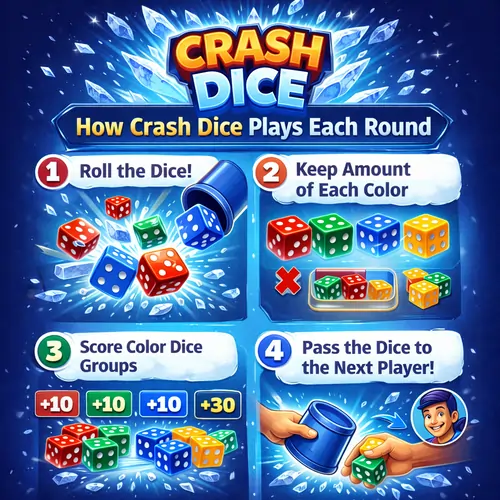
A typical Crash Dice round is broken into three clear steps. First, you choose your stake via the on‑screen controls, adjusting your bet size to match your balance and risk appetite. Second, you hit the button to drop the dice from the top of the board.
As the dice fall, they bounce off pegs in unpredictable ways, briefly changing direction at each impact and building tension as you try to guess where they will land. Finally, the dice settle into one of the multiplier pockets at the bottom, which can range from low‑paying values to high multipliers that significantly boost your win. This last “crash” moment is the core thrill of the game and is what makes Crash Dice enjoyable to watch even when you’re not the one playing.
In spirit, the flow is similar to Plinko, but the use of dice shapes and the specific pocket layout can make Crash Dice feel more focused and slightly different in pacing. Like many instant‑win arcade titles, rounds are short, making Crash Dice well suited to quick sessions during breaks, commutes, or downtime at home in the Philippines.
Difficulty, Learning Curve, and Strategy Feel
Crash Dice is very easy to learn, which is one of its biggest strengths for casual players. There are no complex symbols or payline patterns to memorize; you only need to understand that different pockets carry different multipliers and that the dice path is unpredictable.
The real learning curve is about managing your bankroll and choosing how aggressively you want to chase bigger multipliers rather than mastering a detailed strategy system. Since the outcomes are driven by random number generation and physics simulation, Crash Dice behaves more like a high‑energy, luck‑driven arcade experience than a skill‑heavy game, similar to the crash‑style and arcade games examined in variance and RTP discussions.
For common answer‑engine questions such as “Is Crash Dice hard to play?” or “Do I need a strategy for Crash Dice?”, the most accurate response is that the game is simple and mostly luck‑based, with the main smart choice being to play within your budget and understand the volatility.
Graphics, Sound, and Overall Experience
Crash Dice uses bright, distinct dice graphics, clearly visible pegs, and smooth animation to keep each round engaging from start to finish. As the dice hit the pegs and bounce around, small audio cues reinforce each impact and the final landing, adding to the sense of physicality and suspense.
This audiovisual approach is similar to other arcade‑style titles on Asian iGaming, such as Lucky Ball and other ball‑drop or instant‑win games that rely on bold colors and straightforward animation rather than ultra‑realistic graphics. For mobile players in Northern Mindanao and other regions in the Philippines, this balance means the game runs smoothly on typical Android devices without requiring top‑tier hardware.
Because each round is short, Crash Dice works well in short play sessions, which aligns with how many players dip into mobile games between tasks, during public transport rides, or in the evening when they want quick entertainment rather than long sessions.
RTP and Volatility: What to Expect
Most modern crash, instant‑win, and arcade games are configured with theoretical RTP values around the mid‑90s, often in the 96%–97% range. Crash Dice is likely configured similarly, but exact RTP figures depend on the specific platform, so you should always check the in‑game information or help section on the site you’re using to confirm the precise number.
By comparison, many online Plinko implementations offer a range of RTP settings, often between about 96% and as high as 99% for certain providers and low‑house‑edge configurations. Lucky Ball‑style games and comparable slot or instant‑win titles usually sit around 96%–97% RTP, comparable to regular online slot machines. For players in the Philippines, this means Crash Dice generally feels as “fair” as other mainstream arcade games over the long term, even though short‑term results can swing sharply due to volatility.
In volatility terms, Crash Dice tends toward medium to high, since you can go through stretches of modest returns but occasionally hit significantly larger multipliers. Understanding this helps set realistic expectations: treat Crash Dice as entertainment with the potential for exciting peaks rather than a consistent income source.
Crash Dice vs Plinko
- “If you prefer ball‑drop mechanics with adjustable rows and risk, read our full Plinko review.”
- “If you like the visual style of Crash Dice but want a more slot‑like take on the ball mechanic, check out the Lucky Ball review.”
Pros and Cons of Crash Dice
Pros
- Very visual dice‑drop mechanic that is instantly understandable to new players.
- Simple rules and minimal learning curve make it ideal for casual and mobile play.
- Short rounds fit perfectly into brief gaming sessions throughout the day.
- Appeals strongly to fans of Plinko‑style peg games and other physics‑based arcade titles.
Cons
- Outcomes are largely luck‑driven, with limited room for meaningful strategy.
- Medium–high volatility can feel swingy if you chase big multipliers too aggressively.
- Players who prefer deep strategy or skill‑based games may find it too simple.
- As with all arcade gambling, it’s easy to extend sessions without firm bankroll limits.
Who Should Play Crash Dice?

Crash Dice is ideal for players who enjoy quick, visually engaging arcade experiences and are comfortable with games where luck is the main driver. If you already like watching balls or dice fall through pegs in games like Plinko, Crash Dice will feel like a natural and entertaining variation on that theme.
Players in across the Philippines who frequently game on mobile data will appreciate that Crash Dice is light on resources yet high on visual impact, making it easy to play in short bursts. It also fits well for those who enjoy rotating between several arcade titles on Asian‑style platforms, such as Lucky Ball and other instant‑win or crash‑inspired games.
However, if you prefer games with deeper decision‑making, complex features, or strong skill components, you may find Crash Dice too random and might be better served by other genres or more strategy‑oriented titles.
Pricing, Access, and Where to Play
Crash Dice is typically available within the arcade or instant‑win section of online gaming platforms rather than as a standalone premium title. Many operators bundle it alongside other physics‑based and instant‑win games, letting you easily switch between Crash Dice, Plinko, and Lucky Ball in the same session.
For players in the Philippines, including Northern Mindanao, you’ll often find Crash Dice under categories labeled “Arcade,” “Instant Games,” or “Crash/Plinko” within the platform’s lobby. Flexible bet sizes usually allow you to start with low stakes and gradually increase your wagers only if you are comfortable with the risk and volatility.
Wherever you decide to play, it’s always wise to check local regulations and play only on platforms that are reputable and appropriately licensed in your jurisdiction.
Final Verdict on Crash Dice
Crash Dice delivers a fun, fast, and visually satisfying arcade experience that revolves around the excitement of watching dice bounce through pegs and crash into multiplier pockets. It is particularly well suited to players who want a straightforward, luck‑based game they can enjoy in quick sessions on mobile or desktop, especially in markets like the Philippines where casual gaming is part of everyday downtime.
If you enjoy Plinko‑style games and are looking for a dice‑themed variation with similar tension and spectacle, Crash Dice deserves a spot in your arcade rotation. To help readers compare options and deepen their understanding of the genre, link prominently to your Plinko review and Lucky Ball review, giving them a clear path through your cluster of arcade game content.
