
Color Game is a Filipino dice game where you bet on colors instead of numbers; it is easy to learn, high‑risk, and best treated as casual entertainment with a strict budget.
At a glance:
- Simple three‑dice, six‑color mechanic, popular among Filipino players online and offline.
- You win if your chosen color appears on at least one of three dice, with higher payouts for multiple matches.
- Your per‑round chance of hitting your color is a bit above 40%, so the house still holds an edge over time.
- Best for short, budget‑controlled sessions—not for players looking for consistent profit.
How to Play Color Game
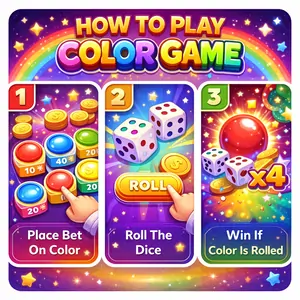
For mobile readers who want quick value, here’s how Color Game works in practice before we dive deeper into background details.
Color Game uses three dice, each showing six colors instead of numbers. The betting layout shows matching colored squares—often vibrant red, bright yellow, deep blue, green, white, and orange—arranged in a simple grid. You place your chips or cash directly on these bold, eye‑catching squares before the roll.
- Choose your color(s).
Tap or place money on one or more colored squares. Many players are drawn to bright red and yellow spaces because they stand out visually on the board. - Place your bets.
Minimum bets can be very small, while online tables clearly show their minimum and maximum bet limits for each round. - Roll the dice.
The operator (or digital system) shakes three colored dice—usually with clearly painted faces so you can see the symbols and colors spin—then reveals the result. Online, smooth animations show the dice tumbling before they land. - Check the result.
You win if your chosen color appears on at least one die. Typical payouts look like this:- 1 matching die: win 1x your bet (plus your stake back)
- 2 matching dice: win 2x your bet
- 3 matching dice: win 3x your bet
Example: If you bet 20 pesos on the bright red square:
- Dice show red, yellow, green → you profit 20 pesos.
- Dice show red, red, blue → you profit 40 pesos.
- Dice show three reds → you profit 60 pesos.
- Dice show blue, yellow, green → you lose your 20‑peso stake.
What Is Color Game?
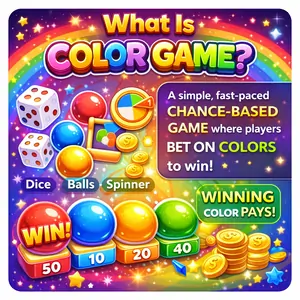
Color Game is a simple gambling game many Filipino players recognize, combining colorful visual design with quick, luck‑based betting. You’ll often see a compact setup with six bold color panels—bright reds and yellows, cool blues and greens—on a board or digital screen.
The core idea is straightforward: you wager on one or more colors, three colored dice are rolled, and payouts are based on how many dice match your chosen color. This simplicity makes Color Game attractive to beginners and casual players who want to jump in without learning complex rules.
For deeper breakdowns of specific implementations and platforms, you can explore this focused Color Game review and an alternate Color Game review that covers another variant and setup.
Types of Color Game Today
You’ll usually encounter Color Game in two main forms:
- Offline Color Game (physical setup)
- Online or app‑based Color Game
Offline Color Game uses real dice and a board painted with strong color blocks so they’re visible even from a distance. You place cash or chips on the colored squares, listen to the operator call out last‑second bets, and watch the dice rattle in a container before landing.
Online Color Game simulates the same three‑dice mechanic using digital layouts, where vivid red, yellow, green, and blue tiles light up on your screen. You tap to select colors, and the system uses an RNG (Random Number Generator) to roll the virtual dice. Many platforms bundle Color Game with other simple titles such as Hi‑Lo, dice games, and wheel‑based games.
Offline vs Online Color Game
| Aspect | Offline Color Game | Online Color Game |
|---|---|---|
| Setting | Physical table/booth with real dice and a color board | Website or mobile app with digital layout and virtual dice |
| Atmosphere | Social, noisy, lots of lights and crowd reactions | Quieter, screen‑based, with sound effects and animations |
| Visuals | Painted or printed boards, real dice | High‑contrast color tiles, glowing effects, animated dice |
| Convenience | Limited by place and time | Play anytime with internet connection on phone or PC |
| Bet limits | Depends on organizer, often small cash bets | Clearly displayed minimum/maximum stakes and balance information |
| Regulation | Varies by location and organizer | Depends on platform licensing and online gambling rules |
If you enjoy this style of quick arcade betting, you might also like:
Gameplay Experience: Offline vs. Online
From a Filipino player’s perspective, Color Game feels like a quick side‑activity—exciting in short bursts but punishing if you keep chasing the thrill without limits.
Offline Color Game Experience
In a physical setup, the Color Game experience is highly visual and social. Under bright lights, the board’s colored squares—especially the vivid reds and yellows—draw attention and invite players to drop coins and bills on them. You hear people talking, operators announcing results, and the metallic noise of dice rattling in a can or cup, which all build anticipation before each reveal.
You can clearly see the dice faces and the colors as they land, watch other players react, and feel the energy whenever a popular color hits.
Online Color Game Experience
Online, Color Game trades the physical table for crisp UI and accessibility. The colored tiles are designed to be highly visible even on small mobile screens, often using bright neon reds, yellows, and blues against dark backgrounds for contrast.
Digital versions often include:
- Smooth dice‑rolling animations
- Clear bet and balance displays optimized for mobile
- Tap‑friendly buttons and tiles so you can play comfortably on your phone
If you like this style of fast, simple gambling, you may also want to look at:
For a blog, this is also a great place to embed a high‑quality image of a Color Game board or a close‑up of the colored dice to match the visual description.
Odds, Payouts, and Risk
Each die has six faces, so the probability of any specific color appearing on one die is 1/6. With three dice, your chance of seeing your chosen color at least once is a bit over 40%, and your chance of missing completely is close to 60%.
| Matching dice showing your color | Typical payout (per 1 unit bet) |
|---|---|
| 1 die | 1x your bet |
| 2 dice | 2x your bet |
| 3 dice | 3x your bet |
Because most rounds return either nothing or a small multiple of your stake, the long‑term expectation favors the house. You might enjoy stretches of frequent small wins, but over enough rounds, the operator still keeps an edge.
Color Game is best viewed as entertainment with a fixed budget, not as a long‑term path to profit.
Simple Strategies and Tips
You can’t change the math behind Color Game, but you can be smarter about how you play.
- Spread bets across multiple colors.
Betting on two or three squares—like red, yellow, and green—can increase your chance of hitting something each roll, though net wins per round may be smaller. - Use flat betting.
Keep your stake size consistent each round to control variance and make it easier to track your budget. - Avoid aggressive bet‑doubling systems.
Doubling your bet after losses can quickly backfire during a cold streak or when you hit table limits. - Set hard limits.
Decide in advance how much you are willing to lose (your entertainment budget), and stop when it’s gone. Likewise, set a win target and walk away when you reach it instead of continuing until your luck turns.
Pros and Cons of Color Game
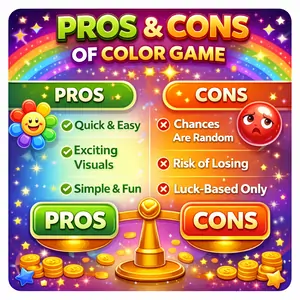
Pros
- Easy entry. Rules are simple and intuitive, even for complete beginners.
- Fast and exciting. Rounds are quick, with constant action and instant visual feedback from the colored dice and board.
- Low minimum bets. Many setups and online tables accept small wagers.
- Strong visual appeal. The bold, colorful design makes it engaging and fun to watch, even when you’re not betting big amounts.
Cons
- Almost pure luck. Strategy and patterns don’t overturn the house edge.
- High volatility. Quick rounds can drain your bankroll if you’re not disciplined.
- Addiction risk. Fast decisions and frequent near‑misses can tempt players to chase losses.
- Regulation may vary. Depending on where and how you play, oversight and licensing can differ.
Legality and Safety for Filipino Players
In the Philippines, how Color Game is treated can vary by setting and operator. Some offline setups may operate under local permits or in loosely regulated contexts, while others are integrated into more formal venues.
Online, legality and safety depend heavily on whether the platform is licensed and transparent. When choosing where to play:
- Look for clear licensing details and regulatory logos.
- Use platforms with secure, reputable payment methods.
- Check for responsible gaming tools such as deposit limits and self‑exclusion.
Avoid sites that hide ownership, skip licensing information, or promise “easy guaranteed winnings.”
Who Is Color Game Best For?
Color Game is ideal for:
- Filipino players who want a fast, easy‑to‑learn game they can enjoy in short bursts
- Casual gamblers who like colorful, visual experiences and simple rules
- Players who can treat their bankroll as an entertainment expense and walk away when it’s gone
It’s not a good fit for:
- People prone to chasing losses or with a history of gambling problems
- Players who prefer deep strategy or skill‑based games
- Anyone expecting consistent, long‑term profit
Compared with Hi‑Lo or Money Wheel, Color Game offers less decision‑making but faster emotional swings, because you can spread bets across several bright color squares and see results in seconds. Hi‑Lo focuses on predicting card direction, while wheel games like Lucky Wheel and Fortune Wheel spread risk across many segments with different multipliers.
If you want similar quick games, consider exploring:
- Hi‑Lo review
- Lucky Wheel review
- Money Wheel review
- Dream Catcher review
- Spin the Wheel review
- Fortune Wheel review
- Bingo review
Final Verdict
Overall, Color Game earns about 7/10 as a casual entertainment option for Filipino players. It combines simple rules, strong visual appeal (especially the bright red and yellow squares on the board), and fast rounds that fit perfectly into short gaming sessions on mobile or desktop.
However, because the odds favor the house and the game is almost entirely luck‑based, it should always be played with strict limits and the mindset that you are paying for entertainment, not investing or earning income. If you manage your bankroll well, choose reputable venues, and avoid chasing losses, Color Game can be a lively and colorful addition to your gaming rotation.
