
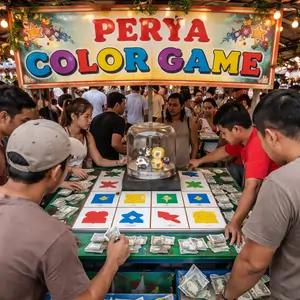
The Perya Color Game is one of the most iconic sights at Filipino fiestas, with its colorful board, clattering dice, and excited crowd shouting for their favorite shades. In this Perya Color Game review, you’ll learn how it works, why it’s so addictive, what the real odds look like, and how modern online versions are bringing this carnival classic to your phone.
What Is the Perya Color Game?
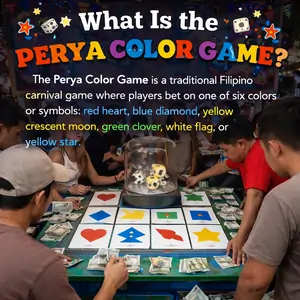
The Perya Color Game is a simple betting game played on a board divided into six colored sections—usually red, blue, yellow, green, white, and orange or pink. Three dice, each face painted with the same six colors, are rolled to determine the winning outcomes; you win when the colors on the dice match the colors where you placed your bets.
Often called “color game ng bayan,” it has been a staple of traveling carnivals, barangay fiestas, and town fairs for decades. Its appeal lies in the mix of bright visuals, loud atmosphere, and very simple rules that anyone can understand in seconds.
If you want to see how this compares to non‑perya versions, you can also check the main Color Game review.
How to Play Perya Color Game
The rules of the Perya Color Game are straightforward, which is why both first‑timers and regulars can jump in with minimal explanation.
- Game setup
- Placing bets
- Rolling the dice
- Payouts
| Matches on your color | Typical payout (per 1 unit bet) |
|---|---|
| 1 die | 1x your bet |
| 2 dice | 2x your bet |
| 3 dice | 3x your bet |
Because rounds are fast—bets, roll, results in seconds—you can win or lose many times in a very short period.
Why Perya Color Game Feels Different
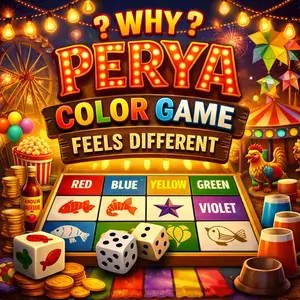
Beyond the mechanics, the fiesta atmosphere is what makes the Perya Color Game unforgettable.
- You see the board’s bright red, green, blue, pink, white, and yellow squares glowing under perya lights.
- You hear the dice rattling in a metal can and the bangka calling “Last bet!” before each roll.
- You feel the crowd react together—groans when a color misses, cheers when a popular color hits.
Columns and cultural features often highlight the Perya Color Game as a living symbol of Filipino fiesta culture, where family, food, rides, and quick games of chance all come together on the same busy street.
If you enjoy this kind of lively, communal feel, you may also like other fast, easy‑entry arcade games such as Dice Roll and Lucky Dice, which capture similar dice‑based excitement in more modern formats.
Odds and Probability: Can You Beat the Game?
Even though the Perya Color Game looks chaotic, the math behind it is clear.
- Each die has six faces, so the chance a specific color appears on one die is 1/6.
- With three dice and fair rolls, the chance that your chosen color appears at least once is a bit over 40%, and the chance it doesn’t appear at all is a bit under 60%.
The standard payouts (1x, 2x, 3x) are not high enough to offset the true probabilities, which means the house still has an edge over many rounds. Operators can keep running the game profitably even though players regularly hit small wins.
Teachers, math examples, and betting guides in the Philippines often use the Perya Color Game to illustrate basic ideas about probability because the setup is easy to visualize and the odds are simple to calculate.
Common Perya Color Game Strategies
There’s no guaranteed winning system, but regulars often use simple strategies to manage their risk.
1. Spreading bets across colors
Many players distribute small bets across two or three colors each round.
- Pros: More chances to hit something each round, fewer completely dead spins.
- Cons: Profits per round are usually smaller, especially if only one of your colors hits.
2. Sticking to a favorite color
Others pick one color (for example, blue or red) and bet the same amount on it every time.
- Pros: Very simple to follow and easy to track results.
- Cons: More volatile—long losing streaks can happen when that color doesn’t appear.
3. Progressive betting (use with caution)
Some “tricks” shared in Filipino communities suggest doubling your bet after each loss until you eventually hit.
- In theory, one win recovers previous losses; in practice, stakes can grow too fast for your bankroll.
- Table limits and long losing streaks mean this approach can lead to big losses, so it’s not recommended for most players.
Experienced players and responsible‑gaming advocates emphasize bankroll control—setting a loss limit and walking away—over chasing any “sure‑win” pattern.
Perya Color Game vs. Online Color Game
The traditional Perya Color Game now has a growing digital twin: online and app‑based versions that bring the same colored‑dice mechanic to mobile and desktop.
- Some platforms offer “Perya Color Game” with carnival‑style graphics, lively sound effects, and quick betting driven by the original format.
- Others use live dealers and real physical dice streamed via video, while RNG versions rely on virtual dice and algorithms.
Articles about this evolution describe how the game has moved “from the fairground to the phone,” allowing overseas Filipinos and younger players to enjoy the Perya Color Game even when there’s no fiesta nearby.
If you want to explore more simple online titles in the same spirit, check out:
- Hi‑Lo review – high/low card guessing
- Money Wheel review – wheel‑spin multiplier game
- Dream Catcher review – game‑show style wheel
Is Perya Color Game Safe and Legal?
The Perya Color Game is widely played at local fairs, but its legal status and oversight can vary depending on where and how it’s run.
- Perya operators often obtain permits for events or amusement activities, but games of chance technically fall under national gambling regulations.
- This means some setups operate in a gray area—tolerated during fiestas but not always formally regulated as casinos are.
For online versions, safety and legality depend heavily on whether the platform is licensed and transparent about its operations and responsible‑gaming tools.
Regardless of format, you should:
- Treat Perya Color Game as gambling, not as guaranteed income.
- Only stake money you can afford to lose.
- Be cautious of unregulated or anonymous online platforms.
Responsible‑gaming resources in the Philippines stress setting limits, recognizing problem signs early, and using self‑exclusion or support services when needed.
Who Is Perya Color Game Best For?
The Perya Color Game is a good fit for:
- Players who enjoy fiesta‑style excitement, noise, and a crowd around the table.
- Beginners who want a game they can learn in under a minute.
- Casual gamblers who treat the game as cheap entertainment and know when to stop.
It’s not ideal for:
- People who struggle to set limits or who tend to chase losses.
- Players looking for deep strategy and long‑term skill edges.
- Anyone expecting consistent, stable profit from gambling.
If you enjoy its fast, luck‑driven nature but want alternatives, games like Lucky Wheel, Spin the Wheel, and Fortune Wheel offer a similar quick‑bet vibe in different formats.
Final Verdict: Perya Color Game Review
As a fiesta staple and cultural icon, the Perya Color Game easily scores around 8/10 for fun, simplicity, and atmosphere. It delivers fast rounds, clear rules, and a shared thrill that keeps people circling back to the table whenever the lights and sounds of a carnival arrive in town.
From a gambling and risk perspective, the game is still pure chance, with odds and payouts that favor the operator over time. That’s why the Perya Color Game is best enjoyed in moderation—set a small budget, treat it as part of the fiesta experience, and walk away when you hit your limit.
For more on digital versions and related games, explore:
